An Inspector Calls
An Inspector Calls is a gripping morality play that exposes the dark underbelly of Edwardian capitalism through a tense, real-time interrogation. It's a highly rewarding text for GCSE because its clear political message and sharp dramatic irony provide endless opportunities for high-level analysis of the writer's methods.
Study Notes
Overview
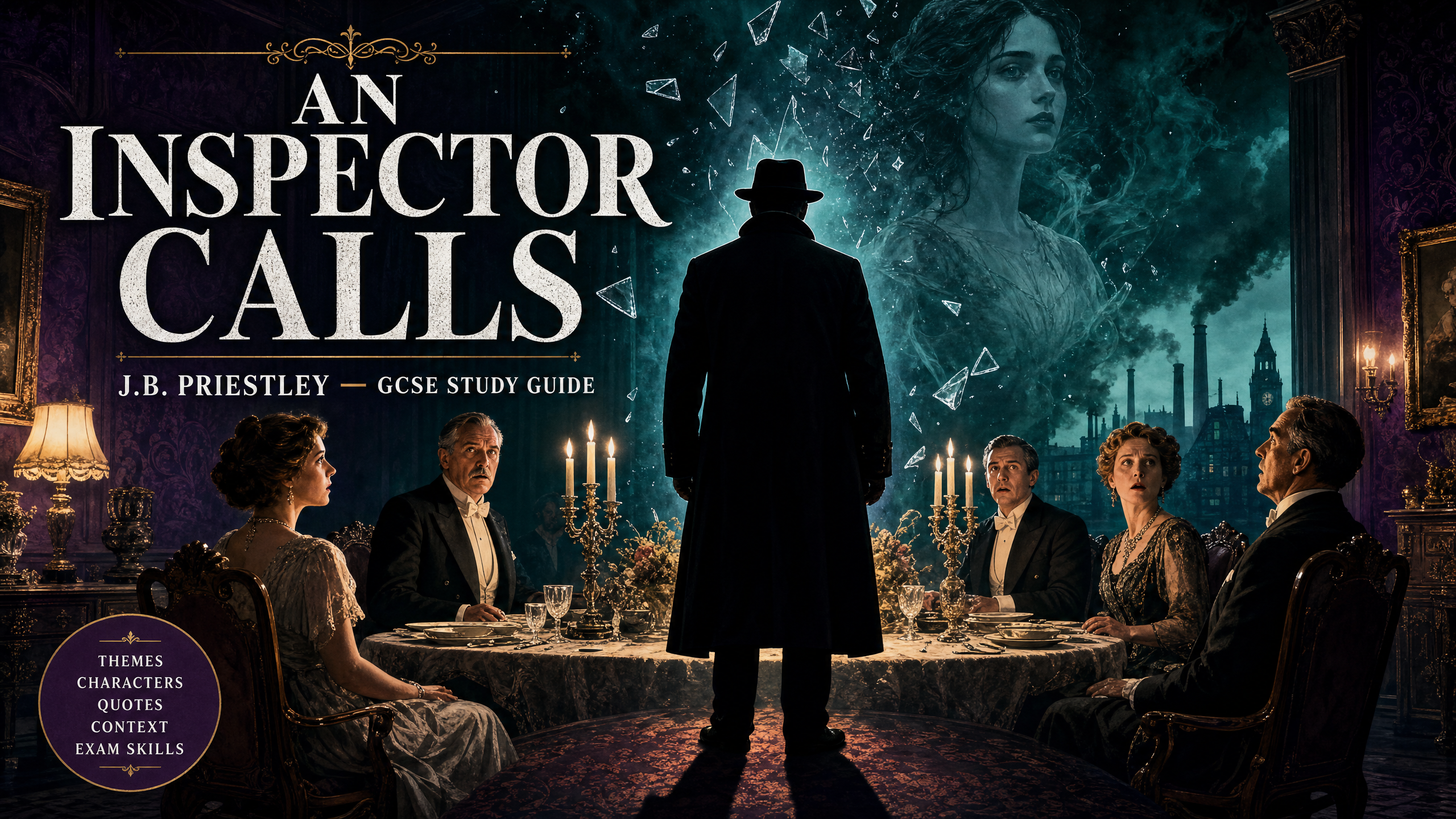
An Inspector Calls is a masterful morality play that functions as a biting critique of capitalist society. Written by J.B. Priestley in 1945 but set in 1912, the play uses this temporal gap to create powerful dramatic irony. Examiners consistently reward candidates who can move beyond character summary to analyse how Priestley constructs these figures to represent ideological positions. A high-level response will seamlessly weave together the play's cyclical structure, the symbolic function of the Inspector, and the stark contrast between the older generation's entrenched selfishness and the younger generation's capacity for change.
Plot/Content Overview
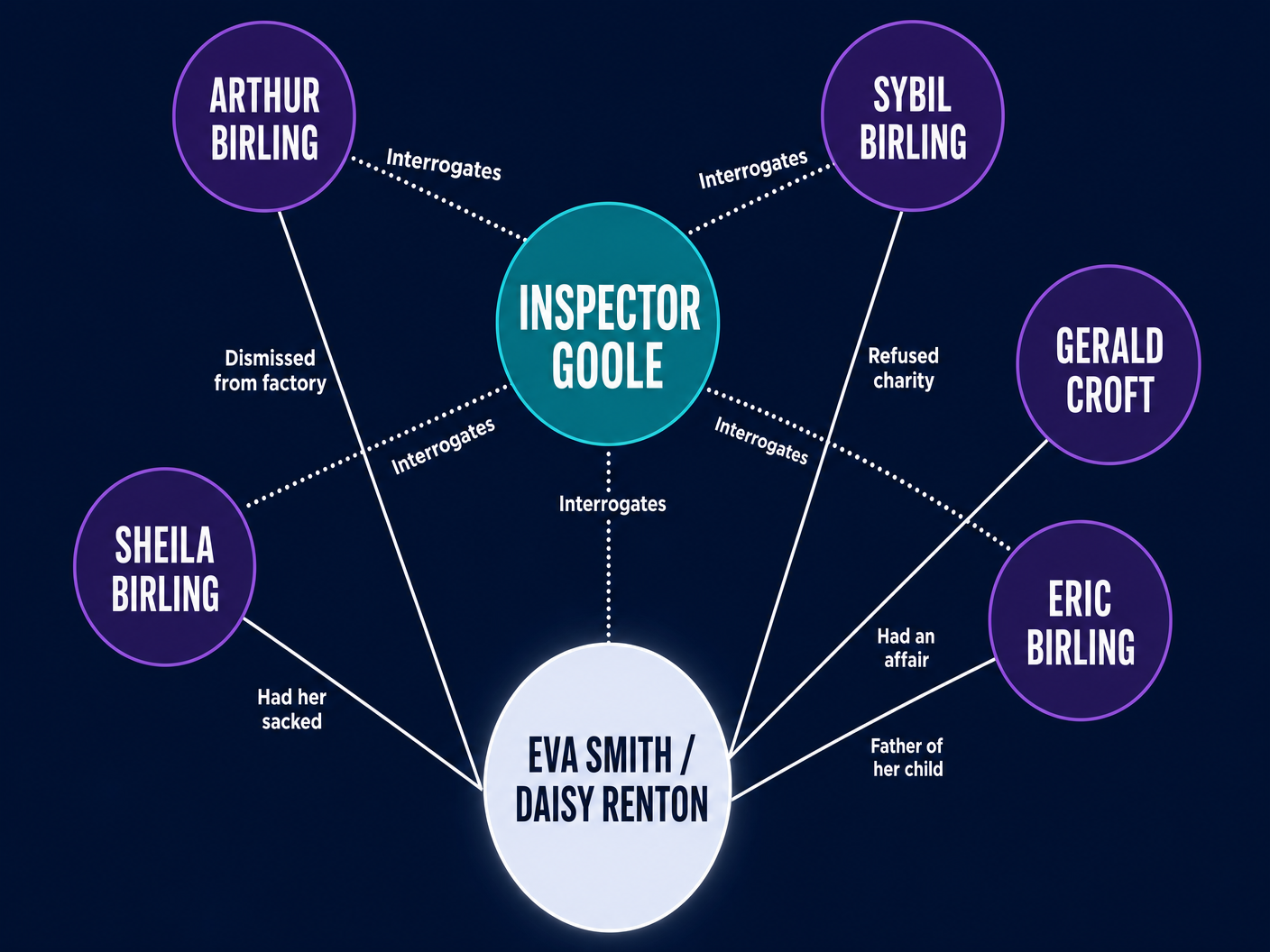
Act 1: The Birling family is celebrating Sheila's engagement to Gerald Croft in their comfortable dining room. Arthur Birling delivers pompous speeches praising capitalism and dismissing the likelihood of war. The celebratory mood is shattered by the arrival of Inspector Goole, who announces the suicide of a young woman, Eva Smith. He reveals that Arthur Birling sacked her from his factory for leading a strike, and that Sheila Birling subsequently had her fired from her next job at Milwards.
Act 2: The interrogation continues. Gerald confesses to having an affair with Eva (under the name Daisy Renton) and abandoning her. Sybil Birling is then questioned; she coldly admits to using her influence at a local charity to deny the pregnant Eva any financial assistance. Sybil triumphantly declares that the father of the child is entirely to blame, inadvertently condemning her own son.
Act 3: Eric Birling confesses that he forced himself upon Eva, got her pregnant, and stole money from his father's business to support her. The family is fractured. However, after the Inspector delivers a powerful final speech and leaves, Gerald discovers that Inspector Goole does not exist on the police force. Arthur, Sybil, and Gerald are relieved and attempt to return to normal, dismissing the evening as a hoax. Sheila and Eric remain deeply affected. Just as Arthur mocks the younger generation, the telephone rings: a girl has just died on her way to the infirmary, and a real police inspector is on his way.
Themes
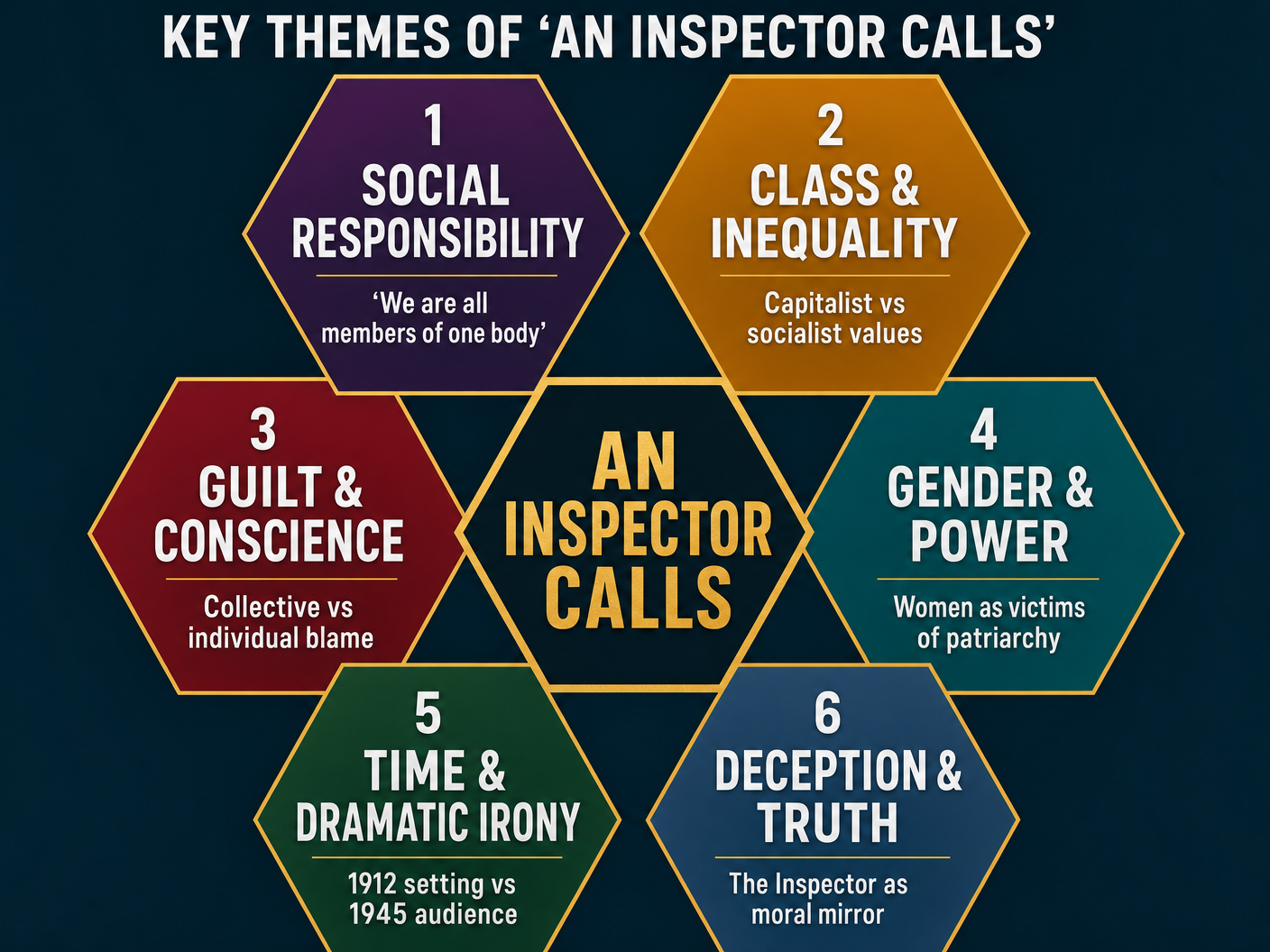
Theme 1: Social Responsibility
This is the central thesis of the play. Priestley contrasts the capitalist view of self-interest with the socialist view of collective responsibility. The play is designed to demonstrate that actions have consequences that ripple through society.
Key Quotes:
- "a man has to make his own way—has to look after himself" (Arthur Birling, Act 1) - Encapsulates the capitalist, individualistic mindset that Priestley seeks to dismantle.
- "We are members of one body. We are responsible for each other." (Inspector Goole, Act 3) - Priestley's core socialist message, delivered directly to the audience.
Theme 2: Class and Inequality
Priestley highlights the stark divide between the wealthy, privileged Birlings and the working-class Eva Smith. The Birlings use their power and status to exploit and discard Eva without consequence.
Key Quotes:
- "If you don't come down sharply on some of these people, they'd soon be asking for the earth." (Arthur Birling, Act 1) - Demonstrates Birling's view of the working class as a resource to be managed, not human beings.
- "Girls of that class-" (Sybil Birling, Act 2) - Shows Sybil's deep-seated prejudice and her refusal to see Eva as an individual.
Theme 3: Age and Generational Divide
The play presents a clear dichotomy between the older generation (Arthur and Sybil), who are rigid and refuse to accept blame, and the younger generation (Sheila and Eric), who are open to change and accept their moral culpability.
Key Quotes:
- "the famous younger generation who know it all. And they can't even take a joke-" (Arthur Birling, Act 3) - Birling's mockery highlights his complete failure to understand the gravity of the situation.
- "It frightens me the way you talk" (Sheila, Act 3) - Sheila recognises the moral bankruptcy of her parents' worldview.
Character Analysis
Arthur Birling
Role: The embodiment of callous Edwardian capitalism and patriarchal authority.
Key Traits: Pompous, arrogant, self-interested, socially insecure.
Character Arc: Birling experiences no moral growth. He begins the play concerned only with profit and status, and ends the play concerned only with avoiding a public scandal.
Essential Quotes:
- "unsinkable, absolutely unsinkable"
- "hard-headed practical man of business"
Sheila Birling
Role: The symbol of hope and the younger generation's capacity for moral awakening.
Key Traits: Initially superficial and vain, but becomes perceptive, empathetic, and courageous.
Character Arc: Sheila undergoes the most significant transformation. She moves from childish compliance to challenging her parents' authority and adopting the Inspector's socialist views.
Essential Quotes:
- "But these girls aren't cheap labour - they're people."
- "I suppose we're all nice people now"
Inspector Goole
Role: Priestley's mouthpiece; the catalyst for the family's unravelling.
Key Traits: Authoritative, omniscient, unyielding, moral.
Character Arc: He remains static, acting as a constant moral force that the other characters react against. He systematically breaks down their defenses.
Essential Quotes:
- "Public men, Mr Birling, have responsibilities as well as privileges."
- "fire and blood and anguish"
Writer's Methods
Priestley employs several crucial dramatic techniques. Dramatic Irony is his primary weapon against Arthur Birling; by having Birling make confident but historically inaccurate predictions (e.g., about the Titanic and the impossibility of war), Priestley immediately discredits his capitalist ideology in the eyes of the 1945 audience.
The play's structure is also vital. It follows the conventions of a 'whodunnit' thriller, but subverts them by making everyone guilty. The cyclical ending—where the play finishes exactly where the real interrogation is about to begin—serves as a stark warning: if society does not learn the lesson of social responsibility, history will repeat itself (a poignant message for an audience that had just endured two World Wars).
Furthermore, Priestley uses precise stage directions to control the mood. The lighting shifts from "pink and intimate" (representing the Birlings' rose-tinted, insulated worldview) to "brighter and harder" upon the Inspector's arrival, symbolising the harsh light of truth and interrogation.
Context
To access the highest marks (AO3), candidates must understand the gap between the play's setting (1912) and its writing/first performance (1945/46). In 1912, Britain was rigidly divided by class, women had few rights, and the country was on the brink of devastating global conflict. By 1945, the audience had lived through two World Wars and the Great Depression. They were exhausted by conflict and inequality, and were on the verge of electing a Labour government that would establish the Welfare State. Priestley uses the 1912 setting to show what society was like, urging his 1945 audience not to return to those destructive, individualistic ways.
Listen to our revision podcast for more in-depth analysis:
Visual Resources
2 diagrams and illustrations
Interactive Diagrams
1 interactive diagram to visualise key concepts
Conceptual Flow Outline
The structural development of tension in An Inspector Calls
Worked Examples
2 detailed examples with solutions and examiner commentary
Practice Questions
Test your understanding — click to reveal model answers
How does Priestley present the differences between the older and younger generations in An Inspector Calls?
Hint: Contrast Arthur/Sybil's refusal to change with Sheila/Eric's acceptance of guilt. Look at how their language changes.
Explore how Priestley uses the character of the Inspector to convey his own opinions.
Hint: Focus on the Inspector as a 'mouthpiece' or 'construct'. Look closely at his final speech.
How does Priestley explore the theme of gender in An Inspector Calls?
Hint: Look at how Eva is treated by the men, but also how Sheila is infantilised by her parents and Gerald.
Explore the importance of the ending of An Inspector Calls.
Hint: Discuss the 'false resolution' when they think it's a hoax, and the final twist of the phone call.